Summary
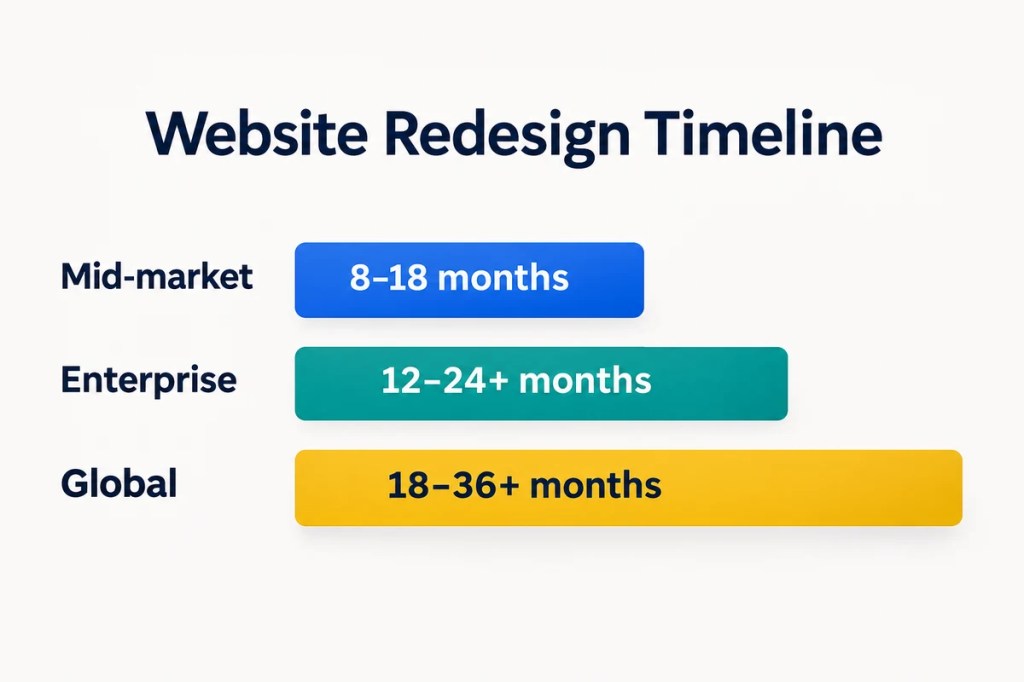
Based on our two decades of experience leading complex website redesigns across Canada, the United States, and global markets, a complete mid-market website redesign typically takes 8 to 18 months, while an enterprise website redesign can take 12 to 24 months or longer. Complex global website transformations involving multiple brands, markets, languages, and technology platforms can take 18 to 36 months or more.
The timeline depends on the complexity of the business, the customer journeys the website needs to support, the amount of content that needs to change, the technology involved, and the organization’s ability to make decisions. These considerations apply across B2B, B2C, and commerce websites, although the emphasis changes depending on the business.
Our estimates draw on experience developing complex digital experiences for organizations including Mazda Canada, Microsoft, The Ottawa Hospital, Youtheory, Jabil, and Dairy Farmers of Canada. Explore our work across industries.
How long does a website redesign typically take?
| Type of website redesign | Estimated timeline |
|---|---|
| Complete mid-market website redesign | 8–18 months |
| Complete enterprise website redesign | 12–24+ months |
| Complex global website transformation | 18–36+ months |
These timelines reflect our practitioner experience and start at project kickoff. They assume that the organization has selected its strategy, design, and implementation partners, established its budget, allocated internal resources, and made decisions about its CMS and broader marketing technology stack.
They also assume that the brand positioning, value proposition, and core visual identity are established. The website redesign may involve developing a digital design system, component library, or website style guide, but it does not include a complete rebrand or brand positioning exercise.
If the organization is still evaluating technology platforms, selecting partners, or redefining its brand, that work needs to be accounted for separately.
1. The seven phases of a website redesign
A complete website redesign typically involves seven phases of work. Understanding the requirements and dependencies of each phase can help marketing and digital leaders develop a more realistic project plan.
| Website redesign phase | Estimated duration |
|---|---|
| Discovery and research | 4–6 weeks |
| Website strategy and requirements | 3–6 weeks |
| Information architecture, content strategy, and UX | 6–10 weeks |
| Creative direction and UI design | 4–8 weeks |
| Development and technology integration | 8–20+ weeks |
| Content production and migration | 4–12+ weeks |
| Testing, training, and launch | 2–6 weeks |
These estimates represent an individual cycle of work within each phase of an enterprise website redesign. Larger programs often involve multiple cycles of UX, design, development, content production, and testing across different areas of the website. Several of these workstreams also run in parallel.
We cover the strategic decisions involved in these phases in more detail in our Website Redesign Checklist.
Phase 1. Discovery and research
Estimated duration: 4–6 weeks
The discovery timeline depends largely on how much the organization already knows about its customers, its business, and the performance of its current website. An organization with recent customer research, audience segmentation, customer journey mapping, and reliable website analytics may already have much of the information required.
For a larger enterprise, discovery may involve engaging stakeholders across different business units, markets, and functions, each with its own priorities and customer requirements. If new primary customer research is needed, the organization should account for additional time for recruitment, research, and analysis.
What you should have at this stage
An understanding of the business objectives, priority audiences, customer journeys, current website performance, competitive landscape, and the opportunities the redesign needs to address.
Phase 2. Website strategy and requirements
Estimated duration: 3–6 weeks
The website strategy establishes what the future experience needs to become and how it will support the goals of the business. The time required depends on how much the role of the website is changing.
A B2B organization may be moving from a website that primarily communicates corporate and product information to one that actively supports customer acquisition and buying decisions. A consumer brand may be moving from a brand-led website to a commerce-first experience. Both represent changes in what the website needs to do, with implications for content, UX, functionality, and technology.
In larger organizations, the timeline also needs to account for stakeholder alignment. Technology teams should be involved during this phase to assess the feasibility of the proposed experience and identify functional and integration requirements.
What you should have at this stage
An agreed website strategy, experience vision, experience principles, business and digital KPIs, and high-level functional and technical requirements.
Phase 3. Information architecture, content strategy, and UX
Estimated duration: 6–10 weeks
The time required to develop the information architecture, content strategy, and UX depends largely on the complexity of the organization’s offering and the number of customer journeys the website needs to support.
A B2B manufacturer with hundreds of products may need to rethink how its portfolio is organized across industries, applications, and technical specifications. A commerce brand may need to develop new ways for customers to discover products, compare options, and make purchasing decisions. These decisions shape the navigation, taxonomy, content requirements, user flows, and page templates.
Content strategy and UX often develop in parallel because the information customers need influences how the experience is structured, while UX decisions influence how that information needs to be presented. An organization with an established taxonomy and content architecture may move through this phase relatively quickly, while one that needs to rethink both should plan for additional time.
What you should have at this stage
A future-state sitemap, navigation model, taxonomy, content strategy, priority user flows, wireframes, and an inventory of the required page templates and components.
Phase 4. Creative direction and UI design
Estimated duration: 4–8 weeks
One of the biggest variables in the design timeline is whether the organization already has a digital design system. An organization with established components, interaction patterns, accessibility standards, and design guidelines has a different starting point from one that has a visual brand identity but needs to develop a system specifically for digital experiences.
The number of unique templates and components also matters. A website with 1,000 pages built from ten reusable templates may require less design and development work than a website with 200 pages that relies on dozens of unique layouts, tools, and interactions.
Design and development teams should work together as the system evolves. Decisions about component flexibility, responsive behaviour, content requirements, and technical feasibility affect how efficiently the website can be built, maintained, and expanded after launch.
What you should have at this stage
An approved creative direction, responsive UI designs, reusable components, interaction patterns, and a documented digital design system.
Phase 5. Development and technology integration
Estimated duration: 8–20+ weeks
The development timeline is influenced by the complexity of the functionality, the maturity of the existing technology infrastructure, and the number of systems the website needs to connect to.
An automotive website, for example, may need to support vehicle discovery, configuration, dealer selection, lead generation, and CRM integration. A commerce website may need to connect product information, inventory, payments, subscriptions, loyalty, and customer accounts. Each of these capabilities introduces development and testing requirements.
A website redesign that retains its existing CMS may benefit from reusable components, established integrations, and existing publishing workflows. A website replatforming project may require the team to rebuild these capabilities on a new platform, even when that platform has already been selected. For an enterprise website, this work may be organized into multiple releases, each introducing new templates, functionality, integrations, or customer journeys.
What you should have at this stage
A functioning website or release in a staging environment, with the required templates, components, CMS capabilities, functionality, and technology integrations implemented.
Phase 6. Content production and migration
Estimated duration: 4–12+ weeks
The content timeline depends on how much existing content can be retained and how much needs to be rewritten, restructured, or created. A redesign that introduces a new product architecture, customer journey, or approach to selling may require considerably more content work than the number of existing pages suggests.
A B2B organization may need new industry pages, solution content, case studies, and technical documentation. A commerce business may need product descriptions, comparison content, photography, buying guides, and educational resources. Organizations operating across multiple markets also need to account for translation, localization, and regional approvals.
Content production can begin once the relevant messaging, content structures, and page requirements are established. Waiting until the website is fully designed or developed before beginning production creates an unnecessary dependency and can extend the overall redesign timeline.
What you should have at this stage
Approved content for the agreed launch scope, populated into the new website, with content ownership, localization requirements, and SEO migration accounted for.
Phase 7. Testing, training, and launch
Estimated duration: 2–6 weeks
The testing period depends on the number of customer journeys, integrations, markets, and functional requirements the team needs to validate. For a commerce website, this may involve testing transactions, payments, promotional rules, subscriptions, and customer accounts. A B2B website may require testing lead forms, CRM integrations, and how inquiries are routed to sales teams.
The project also needs to account for accessibility, performance, security, analytics, content accuracy, SEO migration, and user acceptance testing. These activities should begin during development and be repeated across releases rather than being left entirely to the final weeks of the program.
Larger organizations may also need additional time to train content teams, regional publishers, and website owners on the new CMS, design system, and publishing workflows.
What you should have at this stage
A tested and approved website or release, trained internal teams, validated measurement, and a clear plan for launch and post-launch monitoring.
2. What does an enterprise website redesign project plan look like?
An enterprise website redesign is often better managed as a program of connected workstreams and releases rather than a single linear project. While the initial discovery, strategy, and experience architecture establish the foundations, different areas of the website may move through subsequent phases at different times.
The following is an illustrative 18-month enterprise website redesign project plan.
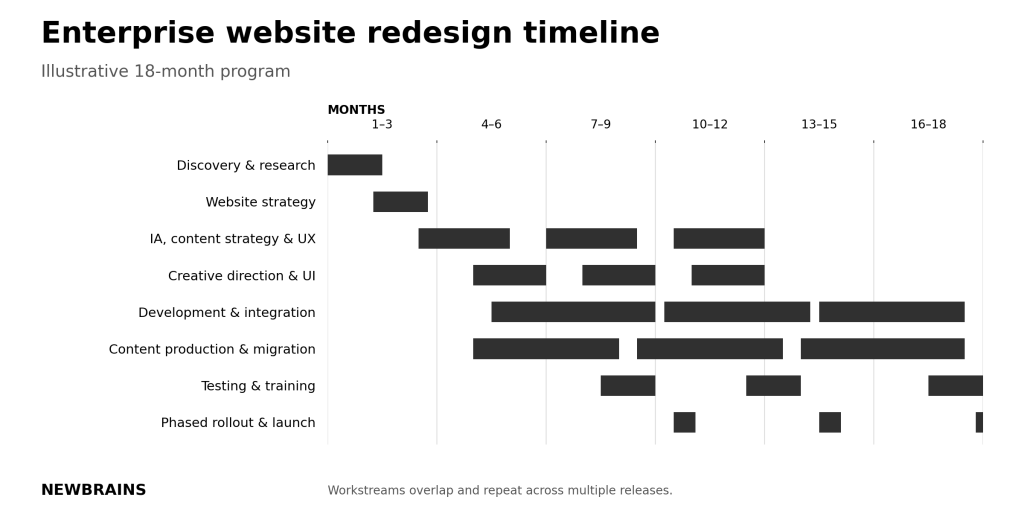
The website strategy does not need to be entirely finished before the team begins exploring information architecture, just as every page does not need to be designed before development begins. Once the foundational components and content structures are agreed upon, different teams can begin working on the parts of the experience for which they have enough information.
The important consideration is the relationship between workstreams. Beginning development before the team understands the content model may create more work later. Beginning content production before the messaging and page requirements are established can have a similar effect.
A good website redesign project plan identifies these dependencies and creates opportunities for parallel work without introducing unnecessary rework.
3. What factors affect a website redesign timeline?
When estimating the scope of a website redesign, it is useful to look beyond the number of pages and consider the complexity of the experience and the organization behind it.
| Factor | What to assess |
|---|---|
| Business complexity | Number of brands, business units, markets, and product categories |
| Customer journeys | Number of audiences, buying journeys, and priority user flows |
| Design system | Existing components, unique templates, and new interaction requirements |
| Content | Volume, new content requirements, languages, and localization |
| Technology | CMS, replatforming, functionality, and system integrations |
| Governance | Stakeholders, decision-making authority, and approval processes |
| Resources | Availability of internal teams, subject matter experts, and implementation partners |
The size of the organization alone is not a reliable indicator of how long its website redesign will take. A mid-market business with a complex product portfolio, multiple customer segments, and extensive technology requirements may require as much time as a larger enterprise with a more focused offering.
B2B, B2C, and ecommerce website redesigns
The underlying redesign process remains similar across B2B, B2C, and commerce, but different business models introduce different requirements.
| Website type | Primary areas of complexity |
|---|---|
| B2B | Product and solution architecture, buying journeys, technical content, CRM, and lead generation |
| B2C | Brand expression, product discovery, audience needs, education, and customer service |
| Ecommerce | Product catalogues, merchandising, checkout, payments, inventory, subscriptions, and loyalty |
| Global enterprise | Multiple markets, brands, languages, regional requirements, and governance |
A B2B manufacturer with thousands of products across several industries may require more time to develop its information architecture and content strategy than a commerce brand with a focused product portfolio. A global consumer organization may require more time for localization and regional stakeholder alignment than either of them.
The business model provides some indication of the work involved, but the actual requirements of the experience are a better indicator of the timeline.
Website redesign versus website replatforming
An important distinction when developing a timeline is whether the organization is redesigning the experience on its existing technology platform or moving to a new CMS or commerce platform.
A website replatforming project introduces additional requirements around platform configuration, data migration, content modelling, rebuilding integrations, security, and training. Keeping the existing platform can reduce some of that work, provided it can support the future experience and the requirements of the business.
Organizational readiness and decision-making
A large website redesign involves decisions that can extend beyond the authority of any single marketing or digital team. Product, brand, sales, technology, legal, ecommerce, and regional teams may all need to participate.
If the organization has not established who owns these decisions, individual workstreams can stall while teams wait for approvals. Changes to product taxonomy, messaging, or functional requirements late in the project can also affect work that has already been completed across content, design, and development.
Establishing decision-making responsibilities, review schedules, and internal resource commitments at kickoff helps the organization manage these dependencies throughout the redesign.
4. How can you shorten a website redesign timeline?
Organizations looking to accelerate a website redesign should first assess which parts of the work they can reuse, which workstreams can run in parallel, and whether the full scope of the redesign needs to launch at the same time.
Existing customer research, brand guidelines, digital design systems, content assets, and technology integrations can provide a starting point for several workstreams. AI can also help accelerate activities such as research synthesis, content classification, prototyping, content production, documentation, and localization. The time saved will depend on how these tools are integrated into the project and whether they reduce work that directly affects the launch date.
Consider a phased website redesign
Rather than waiting for the entire website to be completed, organizations can take a phased approach by launching a minimum viable website (MVP) and introducing additional content, functionality, and customer journeys over time.
A B2B organization may initially focus on its core solutions, priority industries, essential proof points, and lead generation journeys. Additional industry content, technical resources, and interactive tools can follow. A commerce business may prioritize its core product catalogue, product discovery, and purchasing experience before expanding its educational content, buying guides, and loyalty capabilities.
| Initial MVP launch | Subsequent phases |
|---|---|
| Priority customer journeys | Additional customer journeys |
| Core products and services | Expanded product and service coverage |
| Foundational templates | Additional templates and components |
| Essential content | Expanded educational and editorial content |
| Critical functionality and integrations | Additional capabilities and integrations |
The initial launch still needs to provide a coherent customer experience, protect existing search visibility, and meet applicable accessibility, security, and functional requirements. The information architecture, content model, design system, and technology should also be developed with subsequent phases in mind so that the organization can extend the experience without rebuilding its foundations.
For global enterprises, a phased approach may also involve introducing the new experience across different business units, brands, or markets at different times. The first launch represents a milestone within the broader website transformation program rather than its completion.
5. When should you start planning your website redesign?
The redesign timeline begins at project kickoff, but marketing and digital leaders need to account for the organizational work required before that point. Establishing the business case, securing budget, selecting partners, finalizing technology decisions, and aligning stakeholders can all require additional time.
If an enterprise organization is planning an 18-month website redesign program, for example, the internal planning process needs to begin before the program’s intended start date. How much earlier will depend on the organization’s budgeting cycle, procurement requirements, and the decisions that are still outstanding.
Start with the desired launch date and work backward through the major project milestones. If the website is being launched in phases, establish both the initial launch date and the milestones for completing the broader redesign. Identify which decisions need to be made, who needs to be involved, and which resources need to be available at each stage.
This provides a more realistic view of both the website redesign timeline and the organizational planning timeline.
Frequently asked questions
How long does a mid-market website redesign take?
Based on our experience, a complete mid-market website redesign typically takes 8 to 18 months from project kickoff. The duration depends on the complexity of the business, customer journeys, content requirements, design system, technology integrations, and organizational decision-making.
How long does an enterprise website redesign take?
A complete enterprise website redesign typically takes 12 to 24 months or longer. Complex global website transformations involving multiple brands, markets, languages, and technology platforms can take 18 to 36 months or more.
How long does a B2B or ecommerce website redesign take?
A complete mid-market B2B or ecommerce website redesign can take 8 to 18 months, while larger enterprise projects may require 12 to 24 months or longer. The complexity of the product portfolio, buying journeys, content, functionality, and technology integrations will influence the overall timeline.
How long does a website redesign take if you keep your existing CMS?
Keeping the existing CMS can reduce development and migration work if the platform already supports the required content models, components, publishing workflows, and integrations. The amount of time saved depends on how much of the existing technology can be reused and the extent to which the experience itself is changing.
How long does website content migration take?
An individual cycle of content production and migration can take 4 to 12 weeks or longer. For larger enterprise websites, content production and migration may continue across multiple releases throughout the redesign program. Where URLs change, the team also needs to account for URL mapping, redirects, and post-launch search performance monitoring. [2]
Can you launch a redesigned website before the entire project is complete?
Yes. A phased website redesign allows organizations to prioritize their most important customer journeys, content, and capabilities for an initial launch. Additional areas of the website can be developed and introduced over time, provided the initial architecture, design system, and technology can support the broader redesign.
If you are planning a website redesign, our Website Redesign Checklist provides a framework for the strategic decisions that need to be made. You can also explore our website strategy and transformation services and selected work across B2B, B2C, and commerce.
Sources
1. NewBrains
The timeline estimates and project planning framework in this article are based on two decades of practitioner experience across website strategy, digital experience, ecommerce, content, UX, and enterprise website transformation. This includes work led at NewBrains and through prior agency leadership roles.
2. Google Search Central
Site Moves and Migrations. Google’s guidance on URL mapping, redirects, migration planning, and monitoring search performance.

